
More on Selective Intervention

I have long been fascinated by what Nobel laureate Oliver Williamson (1985) described as the “impossibility of selective intervention.”
Thanks for reading Notes from a Strategy Scholar! Subscribe for free to receive new posts and support my work.
This admittedly clumsy terminology relates to the problem that authority seemingly is very hard to exercise in a fine-grained way without undermining incentives, autonomy, or information. I have published various papers over the years on the issue. Below I discuss what the problem is about, and I will then briefly turn to a very recent paper of mine (with some good colleagues) which presents a novel take on the issue.
Williamson’s Framing of the Selective Intervention Problem
Here is how Williamson originally framed the issue. In the The Economic Institutions of Capitalism, he asks the question, Why can’t a firm simply replicate the market internally and intervene only when markets fail? In principle, hierarchy could use market-like incentives, keep autonomous units, and intervene selectively to prevent opportunism or coordination failures.

Williamson’s central claim is that selective intervention by hierarchy is not feasible in practice. Although it might appear that a firm could internalize transactions while preserving the high-powered incentives and autonomy characteristic of markets—intervening only when coordination failures or opportunism arise—Williamson argues that such an arrangement cannot be sustained.
Once transactions are brought inside the firm, authority inevitably changes incentives. High-powered market incentives are weakened because parties anticipate that managerial authority can and will override outcomes when conflicts occur. Even if managers promise restraint, such promises are not credible, since intervention remains always possible. As a result, agents rationally adjust their behavior, leading to reduced effort, strategic conduct, and influence activities such as rent-seeking and lobbying.
This inability to commit credibly to non-intervention lies at the core of the selective intervention problem. In market exchange, contractual disputes are resolved through external enforcement mechanisms, whereas within firms they are settled by managerial fiat. Because internal authority cannot be suspended or selectively withheld, market discipline cannot be preserved inside hierarchy. Anticipating discretionary intervention, parties adapt their behavior ex ante, undermining the very incentive properties that markets provide.
Internal organization also generates systematic information distortions. Rather than responding to market prices, agents respond to internal performance metrics and evaluation systems, which are inherently imperfect. This encourages selective reporting, manipulation of performance measures, and the gaming of internal transfer prices. In addition, hierarchy introduces political costs that replace, rather than eliminate, market transaction costs. Williamson emphasizes internal politics such as budget maximization, bargaining over resources, and coalition-building, all of which consume organizational resources and distort decision-making.
The theoretical conclusion is that because selective intervention is impossible, hierarchy must adopt a coherent governance structure rather than a hybrid that attempts to combine the benefits of markets and authority without their corresponding costs. Firms cannot selectively fix market failures while preserving market incentives; instead, they must accept a distinct set of incentive and control properties that differ fundamentally from those of markets.
My Own Research on Selective Intervention
In various papers, I (with various colleagues) have basically adopted the Williamsonian framing of selective intervention, drawing also on work by other organizational economists (e.g., this paper and this one.
Thus, in a theory-driven case study of hearing aids producer, Oticon, I looked at how selective intervention played out in this firm and made it difficult to sustain its experiment with very flat, decentralized organization. This prompted a concern in this paper with how organization structure may dampen the selective intervention problem (steep hierarchies and therefore informational distance, reputational concerns, unionization, etc.) by making it harder for top managers to intervene. The latter logic is applied to the multinational corporation in this paper . The more procedural aspects of selective intervention is studied using game theory in this paper, We show that “good” headquarters behavior HQ behavior typically involves forgoing opportunities for value creation (i.e., it is second-best, as suggested by Williamson’s analysis), but also that procedural justice systems may sometimes be counterproductive.
The bottomline of all this is that top managers and corporate headquarters are cast in a somewhat negative light: They are tempted to intervene in ways that may be destroy value unless they are constrained by informational distance, reputational concerns and so on. This negative view may be hard to reconcile with the continued existence of top managers and corporate headquarters, and indeed with the existence of managerial authority itself. The purpose of authority in firms is not just to define the rules of the game (design the organization, seed the culture)—but also occasionally to selectively intervene.
New Research
However, in a new article, Phillip Nell, Torben Pedersen, Michael Glock and I take a very different view of selective intervention.
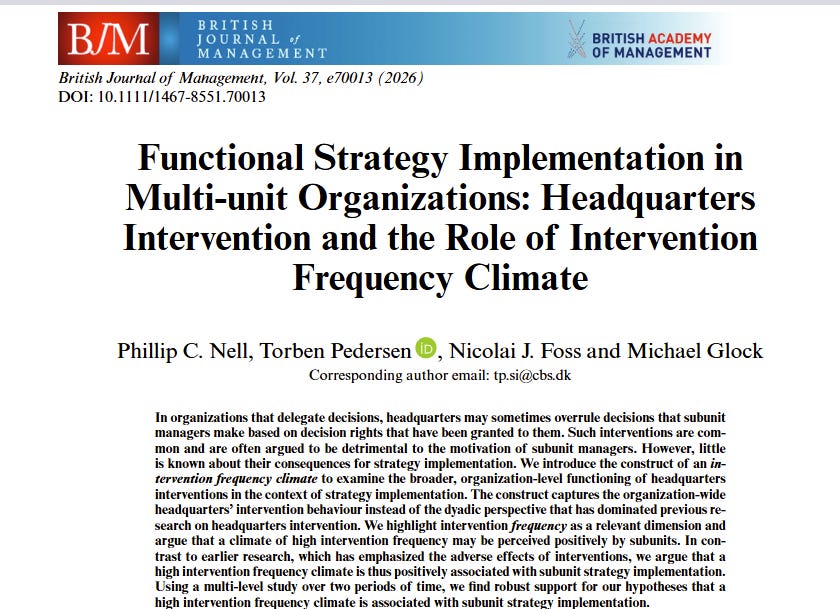
We examine how headquarters’ intervention behavior influences the implementation of functional strategies across subunits in multi-unit organizations. Strategy implementation is a persistent challenge, particularly in multi-business and multinational firms where strategies are formulated at headquarters but executed by decentralized subunit managers. The selective intervention angle is to cast headquarters intervention are potentially harmful as it undermines autonomy and motivation and violate implicit psychological contracts.
However, we argue that the frequency of intervention can generate an organizational climate that positively affects implementation outcomes.
Most prior studies adopt a dyadic lens, focusing on individual headquarters–subunit interactions and largely concluding that intervention is detrimental. By contrast, we argue that this dyadic focus overlooks an important organization-level phenomenon: the intervention frequency climate that emerges when subunits observe how often headquarters intervenes across the organization.
Drawing on the organizational climate literature, we argue that shared perceptions of headquarters’ behavior shape expectations and guide action. From this perspective, frequent intervention need not be interpreted as micromanagement; instead, it may signal guidance, coordination, and seriousness about strategic priorities, thereby supporting effective implementation.
The central construct introduced is intervention frequency climate, defined as the shared perception among functional subunits of how often headquarters intervenes in subunit decision making. Unlike prior work that emphasizes isolated interventions or dyadic relationships, this construct captures collective interpretations of intervention patterns across functions. The point is that subunits do not evaluate headquarters actions in isolation; rather, they infer meaning from broader organizational patterns. A high intervention frequency climate can cue that headquarters is actively engaged in monitoring and supporting strategy execution, increasing alignment with corporate objectives.
The theoretical framework juxtaposes two competing logics. On one hand, intervention may undermine motivation by signaling distrust and reducing perceived autonomy. On the other hand, frequent and visible intervention can communicate stewardship, clarify expectations, and reinforce norms around implementation. We argue that when interpreted through an organizational climate, the latter logic may dominate. Accordingly, we hypothesize that a high intervention frequency climate is positively associated with subunit strategy implementation.
To test this hypothesis, we conduct a multi-level longitudinal study within a large European multi-business financial services firm. The organization comprises multiple corporate functions (e.g., IT, HR), each with geographically dispersed subunits. The sample includes 528 functional subunits nested within 48 functions across 13 countries, with data collected at two time points. Using multi-informant survey data and hierarchical modeling, we assess how function-level perceptions of intervention frequency relate to subunit-level strategy implementation, while controlling for relevant structural and demographic factors.
The results provide strong support for the hypothesis. Functions characterized by a high intervention frequency climate exhibit significantly higher levels of strategy implementation among their subunits. This relationship remains robust across time and controls, suggesting that the climate of frequent intervention matters beyond isolated instances of headquarters involvement.
In all, our study contributes by shifting attention from dyadic intervention effects to organization-level climates, enriching both intervention theory and strategy implementation research. Practically, it suggests that managers should consider not only whether and how they intervene, but also how consistently and visibly their involvement is perceived across the organization. When designed carefully, frequent intervention may enhance clarity and alignment without necessarily undermining autonomy, ultimately improving strategy implementation outcomes.
Where We Differ From Prior Research on Selective Intervention
Traditional thinking on selective headquarters intervention is largely rooted in a cost-based and dyadic view. Prior research typically conceptualizes intervention as an episodic override of subunit decision rights, analyzed within a headquarters–subunit dyad. From this perspective, selective intervention is seen as problematic because it undermines managerial autonomy, signals distrust, and weakens motivation. Drawing on theories such as transaction cost economics and agency theory, the dominant assumption is that intervention should be used sparingly, as its primary effects are motivationally harmful and disruptive to effective strategy implementation.
Our article diverges from this traditional view in three fundamental ways.
First, it shifts the level of analysis from dyadic interactions to an organization-level climate. Rather than treating intervention as an isolated event between headquarters and a single subunit, we argue that subunits observe intervention patterns across the organization. These observations coalesce into a shared perception—what we term intervention frequency climate. This reframing challenges the assumption that subunits interpret intervention solely based on their own experience; instead, meaning is derived from how often and how visibly headquarters intervenes overall.
Second, we reconceptualize the consequences of intervention frequency. Traditional accounts assume that more frequent intervention exacerbates negative effects by further eroding autonomy and trust. In contrast, we propose that frequent intervention can have positive effects when it becomes a predictable and salient feature of the organizational environment. A high intervention frequency climate can communicate guidance, clarity, and active stewardship, signaling that headquarters is engaged in supporting strategy execution rather than merely policing deviations. This view reframes intervention from a sign of failure or mistrust into a mechanism that structures expectations and coordination.
Third, we challenge the logic of selectivity itself. Traditional thinking implicitly treats selective intervention as superior because it preserves discretion while allowing headquarters to correct major problems. We argue, however, that selectivity may create ambiguity and uncertainty if interventions appear sporadic or exceptional. By contrast, frequent intervention—when consistently observed across subunits—can normalize headquarters involvement and reduce interpretive uncertainty about strategic priorities. In this sense, predictability and visibility, rather than restraint, become central to effective implementation.
In sum, then, our article departs from the conventional wisdom that intervention is inherently detrimental and should be minimized. Instead, we propose that the pattern and frequency of intervention matter as much as, or more than, individual intervention episodes. And by highlighting the role of organizational climate, we reframe selective intervention not as a purely dyadic control problem but as a collective sensemaking process that can either hinder or enhance strategy implementation depending on how headquarters involvement is perceived across the organization.