

Last week I was dragged into a spirited Twitter debate on higher education reform. On the one side are conservative and libertarian professors who feel marginalized by the “woke” university but think that gradual and patient reflection, dialogue, and coalition-building are the keys to reform (while they focus on their primary tasks of research, teaching, and service). On the other side are political activists, mostly outside the university system, who want to tear the whole system down and replace it with something that is more ideologically balanced—or perhaps something strongly biased in the opposite direction. Achieving this requires electing the “right” people to office; protesting, boycotting, and defunding established institutions; and creating well funded private (and even public) organizations that are explicitly anti-woke.
It started when the activist and journalist Chris Rufo attacked my colleague Elizabeth Corey who, during a podcast interview, expressed some reservations about Rufo’s methods while acknowledging his accomplishments. I defended Elizabeth, which led to a torrent of responses by Rufo and his admirers, whose larger point seemed to be that conservative and libertarian professors are weak, ineffective, lazy, and cowardly types who prefer to play within the rules at the expense of “winning.” Rufo is described by his admirers (and by himself) as the most effective higher-education reformer of our time, maybe of all time, and anything less than adoration is motivated by jealousy or self-protection. (As a friend of mine quipped, paraphrasing Ibram X. Kendi, “It’s not enough to be pro-Rufo; you must be actively anti-anti Rufo.”)
Elizabeth subsequently outlined her position in more detail in a WSJ article (which did not satisfy Rufo and his team). Others including Kevin Vallier entered the fray. I mostly stayed out, while jumping in with a bon mot here and there. But I now that the furor has died down, I’d like to share a few more substantive thoughts about what is going on and what we might do to improve things. (My discussion is focused on the U.S. but the general ideas should apply to other settings as well.)
The conformity problem
Start with the most striking feature of higher education: its extraordinary resistance to change. Despite superficial variation, most universities look remarkably alike. Four-year degrees. The same menu of majors and minors. Lectures, discussions, papers, exams. Professors with PhDs. The differences between an R1 research university, a liberal arts college, and a community college are real but surprisingly modest, especially given how much the surrounding economy has transformed over the same period. There’s been no Henry Ford or Steve Jobs of higher education—no one who fundamentally reimagined what the product is or how it should be delivered. (I once thought it might be Apple, which suggested a paraphrase of the famous quip about Tolstoy: “Steve Jobs is the Steve Jobs of higher education.”)
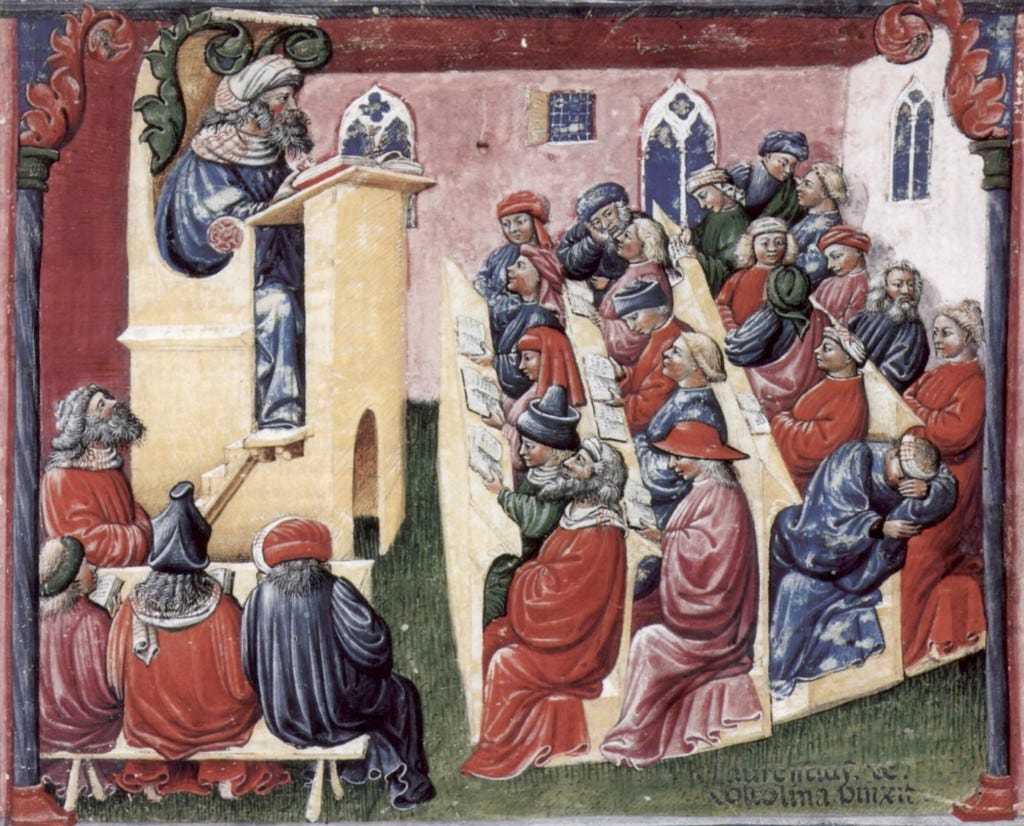

Education, like health care, isn’t a homogeneous blob but a discrete set of goods and services that can be bundled or unbundled, priced creatively, and offered in various shapes and sizes. Yet we treat it as if it’s categorically unique and immune to the normal forces of competition and innovation (perhaps because it generates positive externalities?). Hollis Robbins has a good recent piece arguing that institutional sameness—enforced by the accreditation cartel and state funding requirements—is the real enemy, one that has reduced pedagogy to box-checking rather than genuine teaching. Professors across disciplines are increasingly alienated from their own profession as a result.
The structural and organizational explanation
Part of the explanation for this conformity is selection. Hayek’s 1949 essay on the intellectuals described the tendency of academia to attract people who prefer designing society to acting in the marketplace. This generates a steady, structural pressure toward anti-market attitudes—not as a conspiracy but as an emergent property of who self-selects into the profession. Schumpeter added that is the “absence of direct responsibility for practical affairs” that distinguishes the academic intellectual from others “who wield the power of the spoken and the written word.” The critical attitude of the intellectual arises, says Schumpeter, “no less from the intellectual’s situation as an onlooker—in most cases also as an outsider—than from the fact that his main chance of asserting himself lies in his actual or potential nuisance value.” Combine selection bias with insulation from accountability, and you have a recipe for ideological drift.

The modern university has also undergone a massive expansion in scale, funded largely by the GI Bill, Title IV loans, NIH and NSF grants, and the like. This growth has produced the familiar pathologies of large, weakly governed organizations: bloat, inefficiency, diffuse accountability, and severe information asymmetries. Crucially, no one holds residual control or cash flow rights in the way that shareholders or owner-managers do in a firm. Nicolai Foss and I have argued that corporate wokeness is driven by middle managers—agents who face few internal constraints and can use their discretionary authority to pursue ideological agendas. The same dynamic applies in universities, where DEI bureaucracies and administrative bloat are rarely driven by faculty, students, or senior leadership but by mid-level administrators in HR and student affairs who have found a niche and are filling it. This is not mainly a story about the wrong people with the wrong ideas being in power. It’s a story about incentive structures and the absence of the constraints that, in other organizational contexts, keep such tendencies in check.
A new paper by David Cutler and Ed Glaeser argues that the long-term survival of universities reflects structural advantages of combining faculty autonomy with external control over capital—a model that supports adaptation within the existing form. Scott Masten has related work exploring why universities, like legislatures, are not organized as firms. Both are worth reading. Neither, however, explains the ideological drift of the 20th and 21st centuries—which suggests that organizational resilience and ideological capture are partly independent phenomena. The university form has survived for good functional reasons; what’s been loaded into it lately is a separate question, with a separate answer.
What is to be done
This brings me to what I’d call my middle position on the Great Awokening. There is certainly an ideological element. But the underlying problems are long-term and structural, not primarily the result of bad actors who need to be purged and replaced. The activist model, whether it comes from politicians threatening funding or campus organizers demanding loyalty oaths, tends to leave the underlying structure intact while fighting over who controls it. Battles over speech on state campuses are ultimately fights over state property—political contests like any other, not principled free-speech battles. Winning those fights doesn’t fix the institution; it just changes the faction running it.
The remedy isn’t to capture the existing apparatus but to change the incentive structure that makes it worth capturing. That means promoting private ownership, competition, and entrepreneurship in education. In this sense, I applaud genuinely different models like the University of Austin and the Hamilton School (though their effectiveness remains to be seen), purely private schools like Grove City College, vocational and for-profit institutions, organizations like the Mises Institute, online platforms, and AI-assisted learning. Even chatbots are pretty good at teaching certain subjects! Let a thousand flowers bloom.
We want education entrepreneurs to experiment and discover what works, not a one-size-fits-all solution imposed from above—whether that imposition comes from accreditors, state legislatures, or the federal government. We’re already seeing that top-down reforms can be more symbolic than substantive, something the activists have not recognized or grappled with. We need more bottom-up experimentation, driven by a variety of actors.
What prevents this experimentation is state funding, regulation, and the accreditation cartel. Make institutions sit on their own bottoms, have them compete on multiple margins, and let faculty and students sort into the models they prefer. That’s the reform agenda worth pursuing.
We are on the same page. I didn’t know about your 2023 piece about middle management when I wrote this piece last year. I would have cited you! I will in my forthcoming book, though we disagree on civics centers. https://www.compactmag.com/article/how-business-metrics-broke-the-university/