
Why Firms Don’t Exist?
Steven Cheung’s radical reinterpretation of Coase

Steven N. S. Cheung is one of the great(er) underappreciated economists of the twentieth century. Outside a relatively narrow circle of new institutional economists interested in transaction costs, property rights, and contract theory, his name is probably less recognized than those of Ronald Coase, Armen Alchian, Oliver Williamson, Yoram Barzel, or Douglass North.
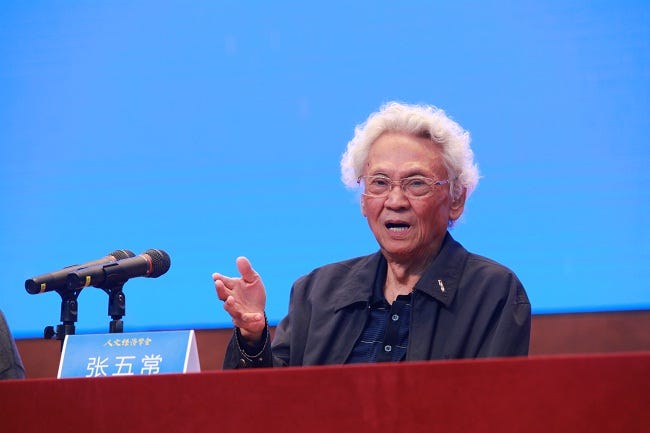
While Cheung may be underappreciated by the profession, he is certainly not lacking in self-esteem (at least in his public self-presentation) and extraordinary confidence in his own intellectual abilities and results. In autobiographical reminiscences published in 2016, Cheung states things like: “if one does not mind the tedious task of going through the Chinese Internet, one would find that I am credited as the founder of contract economics, Coase the founder of transaction costs, and Alchian the founder of property rights.”
Cheung has indeed written several brilliant papers that focus on contracts, property rights, and transaction costs. In “The Theory of Share Tenancy “(1969), he argued that sharecropping can be an efficient contractual arrangement rather than an inherently exploitative one. In “The Fable of the Bees” (1973), he examined externalities and showed how clearly defined property rights can facilitate private solutions. In “A Theory of Price Control” (1974), he analyzed how price ceilings generate non-price forms of competition and resource allocation. Across these works, Cheung emphasized how institutions and contractual arrangements shape economic outcomes in the presence of transaction costs.
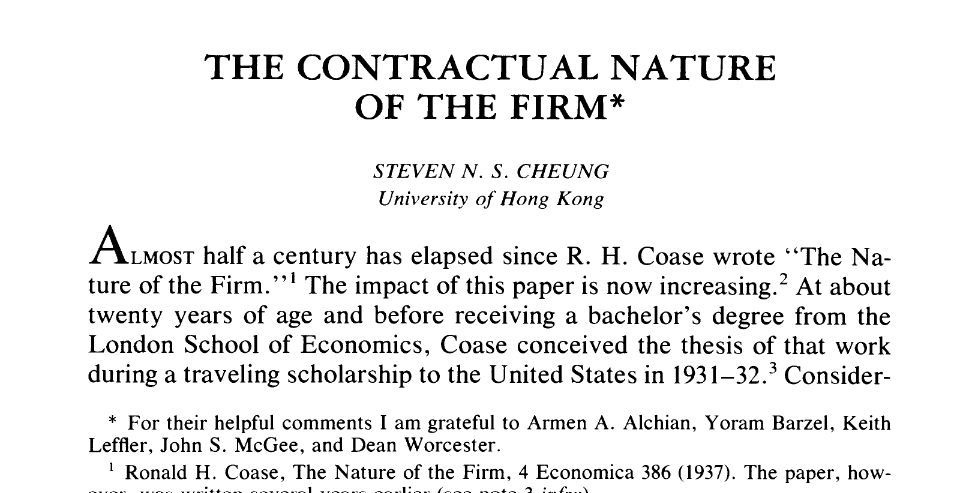
His 1983 paper “The Contractual Nature of the Firm” is perhaps the clearest window into both his intellectual style and his place within what might loosely be called the UCLA property-rights tradition. The paper is ostensibly about Ronald Coase’s famous 1937 article “The Nature of the Firm.” But, in actuality it is doing something more subtle and radical. Cheung is simultaneously interpreting Coase, extending Coase, correcting Coase, and dramatically radicalizing Coase. While I don’t agree with Cheung, I think the result is one of the most elegant and provocative essays ever written about the theory of the firm.
The UCLA counterrevolution
To understand Cheung, however, one first has to understand the intellectual environment from which he emerged. The modern economics curriculum often presents neoclassical economics as if it evolved smoothly from marginalism to general equilibrium to game theory. In reality, a major intellectual rupture occurred in postwar microeconomics. During the 1950s and 1960s, a small cluster of economists associated with UCLA and Chicago began systematically questioning one of the deepest assumptions embedded in standard price theory: the assumption that exchange itself was frictionless.
Ronald Coase opened the door in “The Nature of the Firm” (1937), where he posed an extraordinarily simple but radical question: if markets are so efficient, why do firms exist at all? Why are so many economic activities coordinated internally through managerial authority rather than through prices? His answer was transaction costs. Using markets is costly. Discovering prices is costly. Negotiating contracts is costly. Monitoring performance is costly. Firms arise because, under some conditions, administrative coordination is cheaper than market contracting.
But, Coase’s original paper was more suggestive than fully developed. In fact, part of the fascination of reading Cheung’s 1983 paper is seeing how much interpretive uncertainty still surrounded Coase’s argument almost fifty years later. Cheung explicitly notes that economists had produced wildly different readings of Coase’s thesis and that “we do not exactly know what the firm is—nor is it vital to know.”
That sentence captures something essential about Cheung’s style. He was deeply theoretical but profoundly anti-essentialist (if that is the right word). He distrusted abstract categories detached from observable contractual arrangements. Again and again in his work, he dissolved familiar economic entities into structures of contracts, measurement problems, and property-right allocations.
Alchian, property rights, and institutional realism
This placed him intellectually close to Armen Alchian and Harold Demsetz, perhaps the most underrated economic theorists of the postwar period (scandalously, neither received the Nobel Prize). Both shared Coase’s skepticism toward frictionless textbook models but added an evolutionary and property-rights perspective that profoundly influenced modern organizational economics. Alchian and Demsetz viewed economic institutions less as idealized solutions than as adaptive responses to constraints on information and measurement. Economic organization emerged not from optimization in the abstract but from trial-and-error adjustments to real-world transaction costs.
Cheung absorbed this orientation completely. Indeed, one of the striking features of “The Contractual Nature of the Firm” is how highly concrete it is. Unlike much later work in organizational economics, which increasingly drifted toward abstract formalization (although it is also fair to say that org econ has very much come back to reality over the last couple of decades or so), Cheung remained obsessed with actual contractual practices.
The paper is filled with examples involving hardwood-floor subcontracting in Hong Kong, shirt exporters, bead-stringing homeworkers, and piece-rate manufacturing systems. These examples are not illustrations added after the fact. There is a sense in which they are partly are the theory, laying out mechanisms at a lower level of abstraction.
Cheung’s central move in the paper is deceptively simple. He argues that firms should not be understood primarily as sharply bounded entities replacing markets. Instead, firms are particular forms of contractual arrangements that emerge when direct pricing of every contribution becomes too costly (an idea anticipated in Alchian and Demsetz’ 1972 paper). Referring to Coase’s 1937 paper, Cheung says that it not quite correct to say that a ‘firm’ supersedes ‘the market,’” he writes. “Rather, one type of contract supersedes another type.”
The measurement-cost revolution
The conceptual implications are enormous. In standard textbook economics, markets and firms appear as fundamentally different coordinating mechanisms. Markets use prices; firms use hierarchy. But Cheung insists that this distinction is far less clear than economists imagine. The world is filled with hybrid arrangements: subcontracting, franchising, leasing, sharecropping, piece-rate labor, licensing, partnerships, vertical agreements. The economy is not neatly divided into “markets” and “firms.” It is a continuous spectrum of contractual forms.
This insight places Cheung very close to another great economist in this tradition: Yoram Barzel. Barzel’s work on measurement costs and property rights, clearly initially heavily inspired by Cheung, pushed transaction-cost economics in an even more radical direction. His core argument was that economic organization is fundamentally shaped by what can and cannot be measured economically. Property rights are never perfectly specified because measuring attributes is costly. Contracts therefore emerge as imperfect attempts to allocate rights under conditions of costly measurement. An early classic statement of this is Barzel’s 1982 paper, “Measurement Cost and the Organization of Markets.”
Cheung’s 1983 paper is saturated with this logic. Indeed, the entire essay can almost be read as an extended meditation on measurement problems. He repeatedly argues that firms arise because directly measuring and pricing every contribution is prohibitively costly. Piece-rate contracts occupy an especially important role in the paper because they sit “squarely in between the market and what Coase called the firm.”
Under pure market exchange, every contribution would theoretically be separately measured and priced. Under a pure wage contract, contributions are not directly priced at all; workers are instead paid according to proxy measures such as hours worked. Piece rates sit between these extremes because they directly price some dimensions of output while leaving other dimensions under managerial control. The degree of supervision, hierarchy, and delegated authority depends on how costly direct measurement becomes. In this framework, hierarchy itself becomes an economizing response to costly measurement.
This is quintessential UCLA economics. Instead of beginning with abstract categories like “authority” or “organization,” economists begin with the “primitives” -- property rights, information costs, and measurement problems. Institutions emerge from attempts to economize on transaction costs under imperfect measurement.
Sharecropping, contracts, and the real world
Cheung pushed this logic much further than Coase himself had. Indeed, one could argue that Cheung’s real contribution was to make transaction-cost economics operational (even before Oliver Williamson started doing that also (and in a very different way)). Coase’s original insights were brilliant but elusive. Cheung turned them into a concrete research program centered on contracts, measurement, and observable organizational forms.
His earlier work on share tenancy already demonstrated this orientation. At the time, many economists viewed sharecropping as an inefficient feudal remnant. Cheung attacked this interpretation. Sharecropping was not irrational backwardness; it was an efficient contractual response to monitoring costs, risk-sharing, and information problems. This work became foundational for modern contract theory (also in a “negative” way, as Joseph Stiglitz explicitly credited Steven Cheung’s work on sharecropping, with which he strongly disagreed, with motivating his research program in information economics).
Similarly, Cheung’s work on property rights and common resources challenged simplistic “tragedy of the commons” narratives by emphasizing the actual contractual and institutional arrangements governing resource use. Throughout his career, he displayed extraordinary skepticism toward theories built on abstract assumptions detached from real contractual practices.
The paper’s concluding pages contain a revealing intellectual memoir in miniature. Cheung recalls sitting on a wooden box in Hong Kong while two shoeshine boys spontaneously split the polishing of his shoes. This mundane episode triggered his return to Coase and eventually his research program on contracts.That anecdote perfectly captures the older price-theory tradition at its best: economics begins not with equations but with puzzling observations about ordinary life.
When transaction costs entered economics
The paper also provides a fascinating snapshot of the intellectual revolution occurring in economics during the 1960s and 1970s. Cheung describes a period when concepts such as transaction costs, property rights, and contractual arrangements were still intellectually marginal. Today it is difficult to appreciate how radical these ideas once seemed. At the time, mainstream economics was dominated by highly abstract equilibrium models in which institutions often disappeared entirely.
Cheung and his intellectual allies were pushing economics back toward the real world. And they succeeded spectacularly. The intellectual lineage connecting Coase, Alchian, Demsetz, Cheung, and Barzel (as well as Reuben Kessel, Henry Manne, …) transformed large parts of economics, law, organization theory, and political economy. Modern theories of vertical integration, contracting, corporate governance, franchising, relational contracts, incomplete contracts, institutional economics, and organizational design all bear their imprint.
Why Cheung still feels fresh
Reading Cheung today is striking because of how empirically grounded and institutionally concrete his work feels compared to much work in formal organizational economics. Contract economics often became increasingly formalized and abstract. Cheung remained deeply suspicious of theoretical elegance detached from observable contractual structures.
He was also unusually willing to question categories other economists took for granted. One of the most provocative sections of “The Contractual Nature of the Firm” concerns the ambiguity of firm boundaries. Cheung argues that trying to define firm boundaries precisely is often futile because real economies consist of overlapping contractual arrangements rather than sharply bounded organizations. Subcontractors, franchisees, licensors, contractors, suppliers, and platform participants blur any clean distinction between firms and markets.
In many ways, this argument feels even more relevant today than when he wrote it. Modern digital ecosystems, platform economies, gig work, cloud services, and global supply chains increasingly dissolve traditional organizational boundaries. The old textbook image of the vertically integrated corporation coordinating clearly identifiable employees inside rigid boundaries looks increasingly archaic. Cheung saw this conceptual instability decades earlier.
And perhaps this is why his work still feels intellectually fresh. He approached economics less as a system of settled categories than as an ongoing attempt to explain how real people organize exchange under costly information and imperfect measurement.
The economist who dissolved the firm?
At the end of the paper, Cheung makes a striking prediction. He suggests that transaction costs and contracting may someday rival marginalism itself as a foundational basis for economic analysis. In some ways, he was right. Much of modern economics now revolves around incentive problems, contractual structures, information asymmetries, and institutional design.
Cheung’s work definitely helped shift attention toward contracts, transaction costs, and property rights. Later theories of the firm developed these themes in different directions, focusing on ownership, asset specificity, and incomplete contracts as additional determinants of organizational structure.
On the basis of these later lines of research, it may be questioned whether Cheung’s contractual view of the firm fully captures the importance of ownership and legal organization. He emphasized contracts and transaction costs, arguing that the distinction between firms and markets is often overstated. Later theories of the firm, particularly those focused on asset specificity, incomplete contracts, and residual control rights, placed greater emphasis on ownership and firm boundaries. Corporate law likewise treats firms as distinct legal entities rather than merely collections of contracts. While these developments were not usually framed as direct critiques of Cheung, they suggest that contractual arrangements alone may not explain all aspects of economic organization.
Still, reading Cheung today also reveals how much of his deeper institutional realism has been diluted as these ideas became absorbed into mainstream theory. What made the Coase-Alchian-Cheung-Barzel tradition so powerful was not simply its focus on transaction costs. It was its insistence that economics must begin from real institutional arrangements, actual contractual practices, and observable organizational problems.
Cheung never lost sight of that. And that is why “The Contractual Nature of the Firm” remains such a great read. It is not merely an interpretation of Coase. It is a demonstration of a distinctive way of doing economics: concrete rather than formalistic, contractual rather than categorical. And, unfortunately, a way of doing economics that increasingly seems to be becoming extinct.